

Before migrating to a new CRM, resolve the definitions, record ownership, data quality and process decisions the new system must support. Establish what information should move, how its meaning will be preserved and how connected systems will work. Test complete business responsibilities before committing to the final transfer.
A new CRM can be the right decision. Your business may need capabilities the current platform doesn’t provide, better integration or a structure that supports how the company now operates. The purchase still leaves some work for leadership.
If nobody agrees on what qualifies as an opportunity today, importing those records won’t settle the disagreement. If employees maintain duplicate company records, the migration can carry both versions forward. You can finish the transfer successfully and begin the implementation with the same operating problems.
Start by separating platform limitations from business decisions. Identify what the current software prevents you from doing, what the existing configuration makes difficult and what the organization hasn’t defined.
Those are different problems with different owners. A missing capability may justify changing platforms. A confusing view may require configuration. Conflicting definitions require a business decision regardless of which software you buy.
Document the intended improvement in terms of work. Who should be able to do what after the migration? What information should become easier to find? Which responsibility should become more reliable?
Those answers give you a way to evaluate the new environment. “Move everything into the new CRM” describes a transfer task. It doesn’t establish whether the business will operate better afterward.
Field mapping connects a source value to a destination. Before building that map, establish what the source information means.
Two properties called “Customer Status” may represent different classifications. A field labeled “Revenue” may contain annual company revenue in one place and transaction value in another. Similar names don’t establish compatibility.
The same problem appears in pipeline stages. A stage called “Proposal” could mean the seller sent a document, the buyer agreed to review it or commercial terms are under discussion. Moving all three interpretations into one destination preserves the label while concealing the disagreement.
Resolve the definition, identify how existing records were classified and decide how exceptions will be handled. Some records may need review before they can be mapped responsibly.
Preserve distinctions when the old and new meanings differ. Historical information should remain interpretable after the business adopts a better definition.
Migration scope should follow a business purpose. Some records support active relationships and responsibilities. Others preserve useful history. Some may be obsolete, duplicated or no longer appropriate to retain under the company’s policies.
Define the destination for each group. Active records may belong in the working CRM. Historical material may need an accessible archive or a different retention approach. Excluded information needs a documented reason so its absence doesn’t become a mystery later.
Avoid making the decision through an arbitrary last-activity date alone. A current customer may have limited recent sales activity because the relationship is being served elsewhere. An old record may contain commitments or history relevant to present work.
Ask who needs the information and what they need it for. Zero-Point Selling™ defines Zero Point as the minimum reliable information necessary to make the next appropriate decision. That principle helps establish useful scope without treating every stored value as equally important.
Before transferring records, determine how the business recognizes the same company, person or transaction across systems. Without that decision, imports can create duplicates or connect information to the wrong relationship.
Names alone can be ambiguous. Companies change names, contacts change employers and organizations use multiple locations or domains. Matching rules need to reflect the business’s actual data and account structure.
Review duplicates before merging them. Determine which values survive, how history and associations are preserved and who resolves conflicting information. A merge can remove visible duplication while losing context someone still needs.
Preserve source identifiers where they support reconciliation, integration or investigation. A dependable connection between source and destination records makes it easier to explain what moved and resolve discrepancies.
Test representative matching cases before applying the rules broadly. Include ambiguous records, related companies and contacts associated with more than one relevant organization.
A record owner should represent a current responsibility. Importing an old owner value without review can assign work to former employees, inactive teams or people whose roles have changed.
Define how active relationships and opportunities will be assigned in the new environment. Include unassigned records, shared responsibilities and situations requiring an exception decision.
Keep historical attribution separate where necessary. The person who created a record or completed a past sale may differ from the person responsible for the account now. Preserving both meanings supports continuity without assigning current work incorrectly.
Ownership also applies to data maintenance. Who corrects an association? Who reviews an unresolved classification? Who updates a company fact supplied by an integration?
The migration team can move owner values, but the business must decide what those assignments mean.
A CRM record becomes more useful through its connections. Company, contact and opportunity information needs the right associations so employees can understand the situation.
Include those relationships in the migration design. A transaction imported with its amount and stage can still be operationally incomplete if the relevant buyer or company is missing.
Inspect activities, notes, attachments and commitments as well. Their availability in an export doesn’t establish that they will arrive in a usable form or appear where the receiving employee expects them.
Prioritize the context needed to continue active work. The next seller or delivery employee should be able to understand what happened and what responsibility they now own.
Test the whole record as someone will use it. A field-by-field comparison can pass while the employee still has to search the old CRM to complete the job.
A migration changes the environment connected systems interact with. Review which system owns each important fact, how updates move and what happens when values conflict.
Without that review, an integration can overwrite corrected information or recreate retired records. Two systems may each behave according to their configuration while producing an outcome the business never intended.
Inspect automation before enabling it against imported data. Determine whether a newly imported record could trigger notifications, assignments, tasks or customer communication. Migration activity needs to be distinguished from a genuine new business event.
Define how failures will be detected and who will resolve them. An integration that runs successfully still needs verification that the right information reached the right record.
Keep customer-facing actions under deliberate control during testing and cutover. A transfer should not accidentally restart communication or create obligations nobody intended.
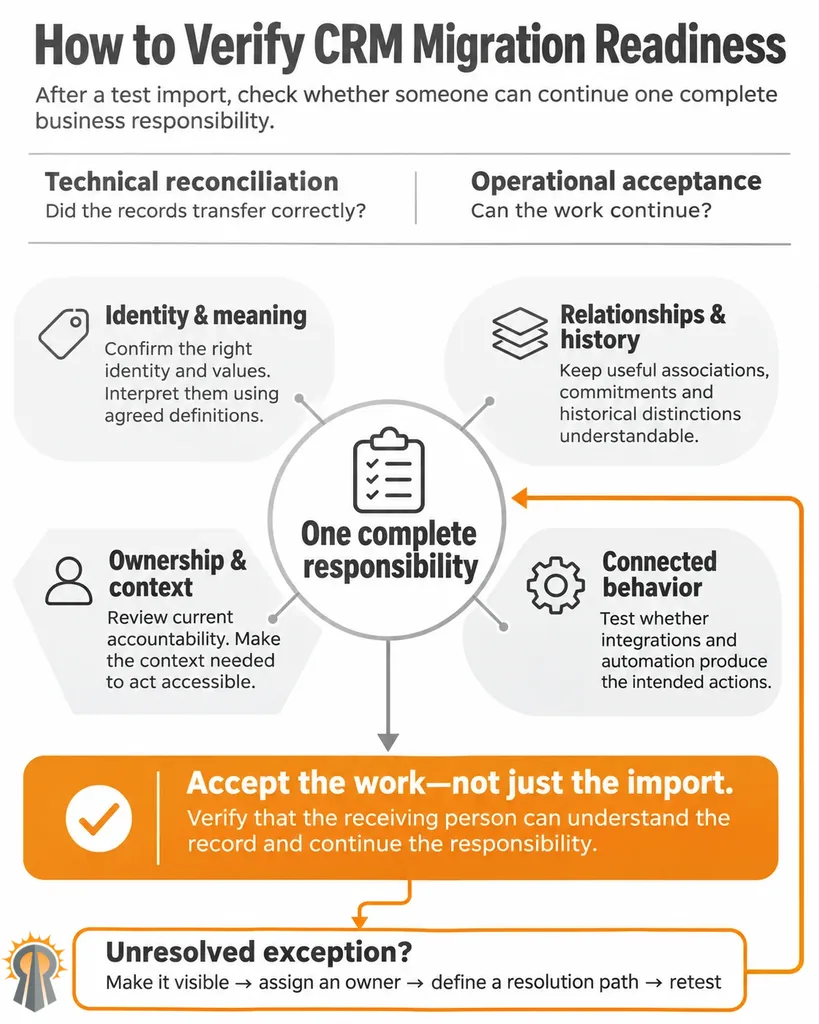
A test import should help answer whether people can operate from the new CRM. Choose records that represent ordinary work and consequential exceptions.
Include an active customer, a new inquiry, an opportunity involving several contacts, a completed transaction and a record with history that matters to delivery. Walk each through the relevant responsibilities.
Your CRM migration checklist should verify:
Reconcile totals and important values, then investigate differences. A successful import message confirms that a technical operation completed; business validation requires inspecting what the result means.
The final transfer needs decisions about timing, changes made during migration and the point at which the new system becomes authoritative for defined responsibilities.
Establish how employees should work during the transition. If both systems remain writable, decide how updates will be reconciled. If work pauses, define the window and the responsibilities that still need coverage.
Preserve appropriate source exports or backups and confirm how recovery would work. A recovery plan should explain what can be restored, who decides and what happens to work created after the transfer.
Set acceptance criteria before cutover. Agree on which issues must be resolved, which can be managed temporarily and who has authority to accept the result.
Employees need task-specific preparation as well. Train them on how to perform their responsibilities in the new environment using realistic records and the agreed process.
Zero-Point Selling uses Strategy → Process → People → Technology as the operating sequence. A CRM migration is an opportunity to make the operating decisions the software must support and preserve them in a more usable environment.
You don’t need to perfect every record before beginning. You need clear scope, defensible rules and a way to resolve the exceptions that matter. Start with the responsibilities whose failure would disrupt customers or active commercial work.
Then evaluate the migration through those responsibilities. Can people continue the work, rely on the information and understand what they own?
Contact Rethink Revenue before your next CRM migration becomes primarily an import project. Bring the business improvements you expect and the work that must continue through the transition. We’ll help you identify the decisions to resolve before the data moves.