


Prevent an owner-dependent CRM implementation by assigning decision authority, process ownership and acceptance criteria before configuration begins. The owner should establish direction and resolve decisions that require executive authority. Other responsible people need enough context and authority to manage routine decisions, test the work and maintain the system.
A CRM project can expose how much of the business still operates through the owner. The team needs a definition, so they ask the owner. Two departments disagree, so they ask the owner. The administrator needs to know what should happen when a customer buys again, and the owner explains it for the third time.
The owner may answer every question correctly and still become the constraint. Work waits, decisions remain verbal, and the implementation team learns that the fastest path is another interruption. Unless the project changes that pattern, the new CRM will depend on the same person as the old process.
Owner dependence develops when the business relies on one person to interpret how work should happen. That person may understand the strategy, customer relationships and exceptions better than anyone else. Their knowledge is valuable, but it becomes difficult to use at scale when every application requires their involvement.
A CRM implementation brings those hidden dependencies into view. Someone must decide what qualifies as an opportunity, who accepts an inquiry, which information delivery needs and how conflicting requests get resolved. If nobody else has the authority or context, each decision returns to the owner.
The project then develops a misleading division of labor. The team appears to own implementation, while the owner supplies the operating logic through a stream of conversations. Configuration advances only as quickly as those conversations happen.
You need a way to turn the owner’s knowledge into decisions other people can apply consistently. Otherwise, the software records the outcome without reducing the dependence.
The executive sponsor provides authority for the business change. That includes confirming the intended outcomes, committing resources and resolving conflicts that exceed the authority of the implementation team.
An external adviser can facilitate those decisions, expose gaps and recommend an approach. Executive sponsorship still belongs with the client-side leader who can authorize the work and its organizational consequences.
Define which decisions require that sponsor. A disagreement about company priorities or departmental accountability may belong there. A routine field label that follows an approved definition usually needs a different owner.
The sponsor also establishes the expectation that responsible managers will participate. A project cannot become less owner-dependent if department leaders can avoid decisions and send every unresolved issue upward.
Make executive attention available for the decisions that need it. Then give the team a usable path for everything else.
The person coordinating the implementation keeps work organized. They track decisions, dependencies, responsibilities and progress. That role matters, but it does not automatically give them authority to determine how Sales or Delivery should operate.
Process owners supply that accountability. They understand the intended result, decide how their team will fulfill its responsibilities and accept the work when it meets the agreed standard.
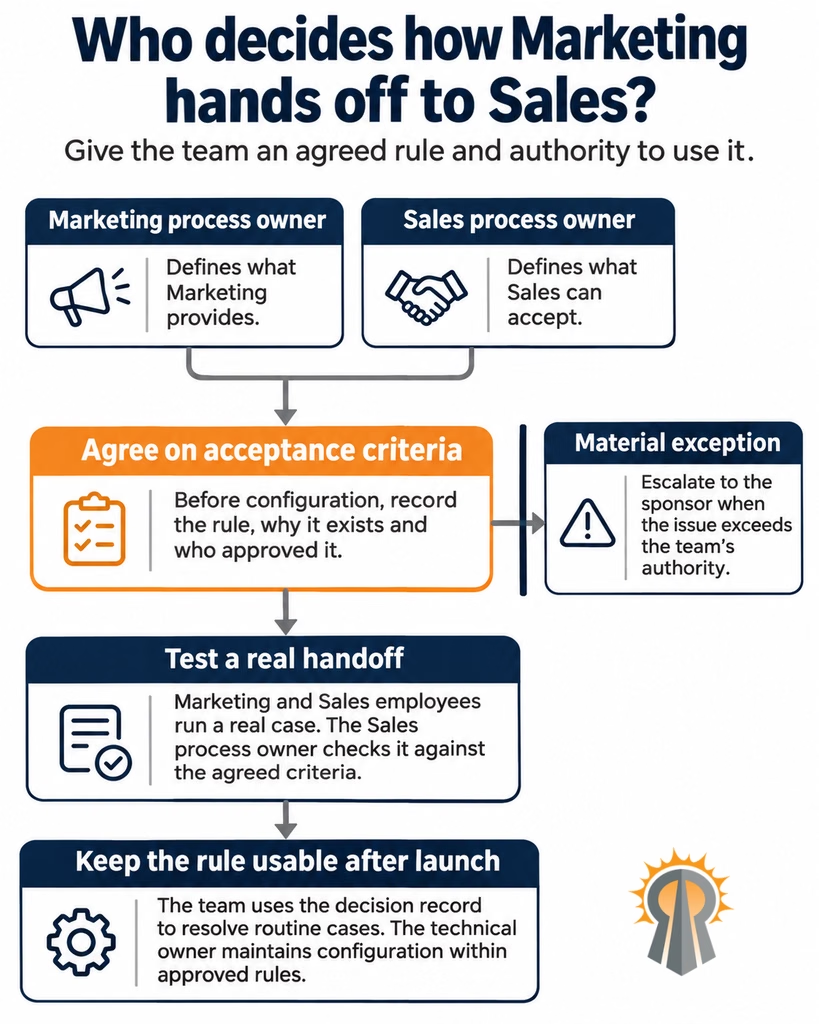
For a Marketing-to-Sales handoff, someone needs authority to define what Marketing provides and someone needs authority to confirm what Sales can accept. The project coordinator can bring them together, but cannot replace either decision.
Technical ownership adds another responsibility. The administrator or implementation specialist determines how approved operating decisions can be represented reliably in the CRM. They should identify constraints and consequences before configuration, including where a request conflicts with the existing design.
One person may hold several roles in a smaller company. Name the responsibilities anyway so everyone knows which authority a decision requires.
A responsibility chart helps only if people can use it when an actual question appears. Establish who decides, who contributes and when an issue needs escalation.
A practical arrangement might assign:
Adjust those assignments to the business. The important part is that a routine decision can reach someone authorized to resolve it.
Define escalation conditions as well. A decision may require executive review because it affects another department, changes cost or risk, or introduces an exception to an approved operating rule.
Without those boundaries, delegation becomes uncertain. People either ask permission for everything or make consequential decisions without realizing what they affect.
An implementation can become dependent on whoever remembers why something was built. The owner answers a question, the administrator configures it, and the decision disappears into a meeting transcript.
Preserve important decisions in a form the team can find and apply. Record what was decided, why, who approved it and which responsibilities or configuration it affects. Include unresolved questions separately so assumptions do not quietly become approved policy.
Keep the record proportional to the decision. A routing rule needs enough explanation for another person to understand its purpose and handle an exception. It does not need a lengthy document that nobody maintains.
When a decision changes, preserve which version is current and what it replaced. Otherwise, employees may follow different instructions while each believes they are using the approved process.
The goal is continuity. Someone should be able to maintain the system without reconstructing every conversation that produced it.
Owners often become the final test for everything because nobody established what completion means. The team demonstrates a screen, then waits for the owner to decide whether it looks right.
Replace that vague review with acceptance criteria tied to real responsibilities. What must an employee be able to do? What information must reach the next person? Which condition should trigger a workflow, and what result should follow?
The process owner should approve those criteria before the work is built. Employees who perform and receive the work should help test whether the implementation satisfies them.
This gives the owner a more useful review. They can inspect material outcomes, exceptions and unresolved decisions instead of approving every screen detail.
Acceptance also needs evidence. A configured workflow is ready for operational use when testing shows that it handles the agreed situations and exposes failures appropriately.
A useful implementation test is to follow a responsibility without asking the owner to explain it. Use a real situation and observe whether the team can understand what should happen.
Can Sales decide whether an inquiry meets the agreed acceptance conditions? Can Delivery identify what it is receiving? Can the administrator investigate a workflow using the recorded rule and its intended result?
Where people stop, determine what is missing. They may need a definition, authority, training or access to information. Each gap should have a responsible person and a corrective action.
Zero Point is the minimum reliable information necessary to make the next appropriate decision. Apply that principle to the team itself. Have you given people enough reliable context and authority to make the decisions you expect them to own?
If the answer keeps depending on another conversation with the founder, the operating design remains unfinished.
Delegation needs a dependable way to review progress and resolve exceptions. Without one, questions collect until someone interrupts the owner or waits for the next large project meeting.
Use a regular implementation review to inspect completed work, decisions needed and dependencies affecting the next step. Give decision owners enough information to prepare, and identify what approval is actually required.
Keep routine status reporting separate from issues that need judgment. The meeting should help people resolve work, rather than require everyone to narrate what a shared project record could already show.
The owner can then focus on the decisions that affect direction, resources or unresolved cross-functional responsibilities. Process owners remain accountable for participating and following through.
That rhythm also makes delays visible. If a configuration task is waiting on a business definition, the project should show that dependency clearly instead of treating it as an unexplained technical delay.
Owner dependence can return when the implementation team leaves. Establish ongoing responsibility before handoff.
Someone needs to manage configuration changes, inspect data and process problems, maintain decision records and coordinate improvements. Department leaders still need to own the responsibilities their teams perform through the CRM.
An external partner can provide technical administration or advisory support. The business needs internal authority to decide priorities and accept operating changes.
Test the handoff as carefully as the workflows. Can the receiving people explain the important rules, find the relevant documentation and resolve ordinary issues? Do they know when outside help or executive judgment is required?
A launch should leave the business with a system it can operate and improve.
Zero-Point Selling™ follows Strategy → Process → People → Technology. A CRM implementation should make the strategy usable through defined work, capable people and supporting technology.
The owner’s knowledge helps establish that design. The project needs to preserve it in definitions, responsibilities and decisions that other people can apply. That is how the business gains capacity without requiring the owner to personally interpret every situation.
Start with the questions that repeatedly return to you. Identify which require executive authority and which expose missing context or delegated responsibility. Resolve those gaps as part of the implementation.
Contact Rethink Revenue if your CRM project keeps waiting for the owner. Bring the decisions that repeatedly stall and the people expected to carry them forward. We’ll help you establish the authority, process ownership and implementation structure needed to keep the work moving.